

Categories(657 Blogs)
Select Category
- All Blogs (657)
- Education (203)
- General (142)
- Student Life (122)
- Technology (117)
- Teaching (92)
- Activities (50)
- EdTech (42)
- Education Standards (37)
- Management (37)
- STEM (29)
- Parents (27)
- Books (18)
- College (17)
- Infographics (15)
- Movies (14)
- Early Education (12)
- GPS & Transport (12)
- Quotes (11)
- School Management (10)
- School Apps (9)
- Smart Card (9)
- Timetable (5)
- Attendance (3)

Mercury Planet Facts For Kids : Color, Size, and Symbol
Mercury Planet Facts For Kids: Color, Size, and Symbol
Learning about the world of solar systems is always a fantasy for kids. Knowing more about the sun and the eight planets add a lot of value to their repository of knowledge. Out of all the planets, Mercury planets facts always come under a special arena as it is closest to the sun and fastest of the planets. Surprisingly, it is not really hotter as expected despite being so close to the sun. It voyages through space with 50km per second or 31 miles per second. Kids would be eager to learn more about this amazing planet including its color, size, symbol, and a lot of interesting, informative, and fun facts. Let us have a look into more details regarding Mercury.Table of Content
-
Mercury planet - Introduction
-
Mercury Planet Facts
-
Planetary Data for Mercury
-
Mercury Planet Colour
-
Mercury Planet Size
-
Mercury Planet Symbol
-
Final Remarks
Mercury Planet - Introduction
If you take a look at the eight planets, Mercury is still a mystery as even experts could find only very less information about it and many of the basic questions are unsettled. And that is what makes the planet more interesting. This terrestrial planet doesn’t have an atmosphere and is rocky and small. This smallest planet of the solar system goes around the sun every 88 Earth days. Kids would be surprised to learn that they will have a birthday once in three months if they were living in Mercury. Unlike some other planets, it does not feature any rings or moons. Just because of the proximity, the planet is not easily seen apart from the time of twilight.
It completes 3 rotations about its axis for each of the 2 orbits of the Sun. Interestingly; the Mercury planet can be seen as moving across the sun’s face from Earth thirteen times a century and the event is referred to as a transit.
Unlike some other planets, it does not feature any rings or moons. Just because of the proximity, the planet is not easily seen apart from the time of twilight.
It completes 3 rotations about its axis for each of the 2 orbits of the Sun. Interestingly; the Mercury planet can be seen as moving across the sun’s face from Earth thirteen times a century and the event is referred to as a transit.
Mercury Planet Facts
Kids would love to hear a lot of interesting facts regarding the planet. Some of them will be fun facts, others will be more informative, but the most discussed are related to Mercury planet history. Let us have a look. 1) The planet is said to have got its name from the messenger of the gods, Roman deity ‘Mercury’ 2) If you look at the structure of Mercury, it is almost similar to the planet Earth.
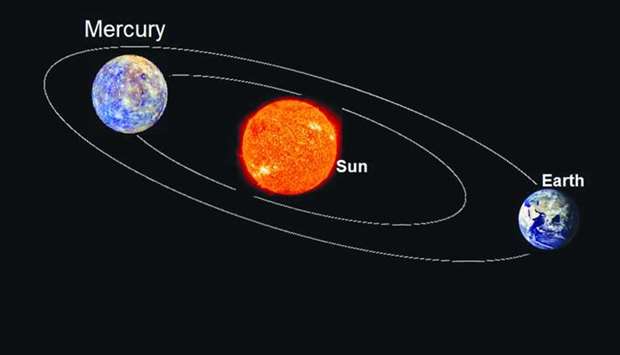 3) The BepiColombo spacecraft is programmed to reach the planet by 2025.
 4) Galileo made the first most telescopic observations of the planet long back in the early 17th century.
 5) Giovanni Zupi observed the planet through a telescope to identify its orbital phases that resembled that of Venus and the Moon in 1639.
 6) Mercury was provided different names for its emergence as both an ‘evening star’ and a ‘morning star’.
7) Imagine when Mercury is close to the sun, you just stand on it and observe the sun. When compared to the view from Earth, the sun would be seen as more than three times bigger.
8) If you compare your weight on Earth with that in Mercury, it would be just 38% of the former. There is no wonder why many people wish to migrate to Mercury (kidding!)
9) It will take 176 Earth days to complete a day on Mercury’s surface.
10) The neighboring planet of Mercury is Venus.
11) It is certainly not visible while the sky is completely dark as the setting and rising of the planet is almost within 2 hours from that of the sun.
12) Two spacecraft, MESSENGER and Mariner 10 have visited the planet.
6) Mercury was provided different names for its emergence as both an ‘evening star’ and a ‘morning star’.
7) Imagine when Mercury is close to the sun, you just stand on it and observe the sun. When compared to the view from Earth, the sun would be seen as more than three times bigger.
8) If you compare your weight on Earth with that in Mercury, it would be just 38% of the former. There is no wonder why many people wish to migrate to Mercury (kidding!)
9) It will take 176 Earth days to complete a day on Mercury’s surface.
10) The neighboring planet of Mercury is Venus.
11) It is certainly not visible while the sky is completely dark as the setting and rising of the planet is almost within 2 hours from that of the sun.
12) Two spacecraft, MESSENGER and Mariner 10 have visited the planet.
 Image: Messenger Space Shuttle
 Image: Mariner 10
13) Due to the short year and slow spin, the sun will take a lot longer to set and rise there. For every 180 Earth days, there will only be a single sunrise.
14) The discovery of Mercury cannot be credited to a single person as it is possible to be observed in the night sky by no need for binoculars or telescope.
15) As there is no atmosphere in Mercury, there are no weather variations like winds, storms, clouds or rain.
16) On average, Mercury is almost 48 million miles far from the planet Earth.
17) The temperature of the planet fluctuates from 801 Fahrenheit all through the day to -279 Fahrenheit during the night
Image: Mariner 10
13) Due to the short year and slow spin, the sun will take a lot longer to set and rise there. For every 180 Earth days, there will only be a single sunrise.
14) The discovery of Mercury cannot be credited to a single person as it is possible to be observed in the night sky by no need for binoculars or telescope.
15) As there is no atmosphere in Mercury, there are no weather variations like winds, storms, clouds or rain.
16) On average, Mercury is almost 48 million miles far from the planet Earth.
17) The temperature of the planet fluctuates from 801 Fahrenheit all through the day to -279 Fahrenheit during the night
Also Read: Solar System For Kids: Planets and Facts
Planetary Data for Mercury
| Eccentricity of orbit | 0.2056 |
| Mercurian year | 87.97 Earth days |
| Mean synodic period* | 116 Earth days |
| Radius (mean) | 2,439.7 km |
| Mass | 3.30 × 10²³ kg |
| Mean surface gravity | 370 cm/sec2 |
| Rotation period (mercurian sidereal day) | 58.646 Earth days |
| The inclination of the equator to orbit | 0° |
| Mean surface temperature | 440 K (332 °F, 167 °C) |
| Typical surface pressure | about 10−15 bar |
| The average distance from the sun | 57,909,227 km (0.39 AU) |
| Number of known moons | none |
| Maximum visual magnitude | −1.9 |
| Mean orbital velocity | 47.36 km/sec |
| Surface area | 74,797,000 km2 |
| Mean density | 5.43 g/cm3 |
| Escape velocity | 4.25 km/sec |
| The mercurian mean solar day | 175.9 Earth days |
| The inclination of the orbit to the ecliptic | 7.0° |
Mercury Planet Colour
Each of the planets is represented by different colors that indicate their composition and based on the way their atmospheres or surfaces absorb and reflect sunlight. Mercury planet has a rocky surface and a thick coat of dust covers it. The dust and igneous silicate rocks may be the reason for its dark gray color. However, the color of Mercury that would appear to the human eye may be different. Also, these colors showcase the chemical, physical and mineralogical differences linking the rocks that form the Mercury's surface.
Different from other Solar System planets, Mercury is simply bare rock. Even when it features a tenuous atmosphere, space and ground observations could spot only the gray color. Following the solar system formation billions of years ago, the molten surface of the planet got cooled and toughened to result in the Mercury planet color.
However, the color of Mercury that would appear to the human eye may be different. Also, these colors showcase the chemical, physical and mineralogical differences linking the rocks that form the Mercury's surface.
Different from other Solar System planets, Mercury is simply bare rock. Even when it features a tenuous atmosphere, space and ground observations could spot only the gray color. Following the solar system formation billions of years ago, the molten surface of the planet got cooled and toughened to result in the Mercury planet color.
Mercury Planet size
Another interesting area of discussion is regarding Mercury planet size. The width of the planet is more or less similar to the Atlantic Ocean. If you consider the area of Earth, almost 18 Mercury planets can be accommodated. A closer look will say that it is only somewhat bigger than Earth's moon. In fact, it is eighth in mass and size of all the planets. The composition of the planet is interesting as its 30% comprises silicate material and about 70% is metallic. The density is just less than that of Earth and so it is the second-highest in terms of density in the Solar System planets. The core of Mercury should have iron and must be large to have this high density.
Mercury Planet Symbol
A planetary symbol or planet symbol is a graphical representation used in astronomy and astrology in order to characterize a classical planet. And just like other features, Mercury planet symbol is also another important area of discussion. The planet is represented by the symbol ☿. This symbol in fact symbolizes the winged cap and head of Mercury, God. However, the International Astronomical Union (IAU) doesn’t really encourage the use of the planet symbols in the present journal articles.
Final Remarks
Mercury is one of the most discussed among the eight planets of the solar system and the reasons are obvious. Experts in this field are still eager to find answers to a lot of unanswered questions regarding Mercury planet facts. A new data hinted that water ice may be present at the bottom sides of craters at the planet's poles. As the days pass, more and more interesting and surprising information about the planet is expected to get explored.Recent Blogs
Our Educational Services


Popular Blogs
Subscribe

SUBSCRIBE TO OUR NEWSLETTER
Sign Up and Recieve the Latest News
Don’t Worry, We Don’t Spam






Copyright © 2026, Edsys Pvt Ltd. All Rights Reserved | Digital Marketing by Joint Views | Privacy Policy | Cookie Policy |
Explore Our Extensive Researched Educational App Directory
Visit Now